

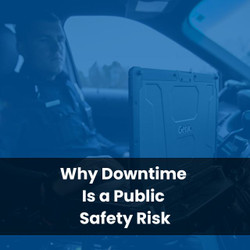
Why Downtime Is a Public Safety Risk
Posted by Beth Stapleton on 30th Apr 2026

In public safety and field operations, technology failure isn’t just frustrating, it introduces operational risk.
When rugged devices fail in the field, the cost isn’t limited to repair. It can mean delayed reporting, lost situational awareness, compromised safety, and reduced service continuity.
That’s why warranty coverage isn’t a footnote, it’s a strategic decision. And it’s why agencies increasingly turn to Getac.
The Real Cost of Downtime
Traditional hardware support models assume devices operate in office environments. Public safety realities are different.
Field hardware faces:
- Vibration and constant motion
- Temperature extremes
- Moisture, dust, and impact
- Long shifts with no charging access
A failed device in these conditions can remove a responder’s access to critical systems, and replacements often take weeks.
What Makes Getac’s Warranty Different
Getac’s five‑year warranty is designed around operational continuity. If a device fails, agencies receive:
- No‑cost replacements
- Pre‑configured devices
- No long RMA cycles
- No reimaging delays
The replacement arrives ready to deploy.
Continuity as a Design Principle
Instead of repairing equipment after failure, Getac’s model emphasizes keeping people working.
This approach minimizes disruption, preserves productivity, and ensures technology never becomes the weak link in the mission.
Reliability Beyond the Spec Sheet
Durability matters, but so does lifecycle support. Getac devices are supported for long deployments, reducing surprise costs and replacement churn.
For agencies managing tight budgets and critical operations, predictability is power.
Warranty as Risk Management
In the field, uptime equals safety. Getac’s warranty isn’t just coverage, it’s protection against operational uncertainty.
Click here to learn more about Getac rugged solutions.